

The earth has witnessed climate changes over time, but the current warming is occurring at an unprecedented pace compared to the last 10,000 years. The Intergovernmental Panel on Climate Change (IPCC) asserts that since the 1970s when systematic scientific assessments commenced, the impact of human activity on climate warming has transformed from a theoretical concept into an acknowledged reality. Nevertheless, it is quite interesting to revisit the historical data of 10,000 years provided from another perspective.
Based on a technical point of view, the dynamic behavior of carbon dioxide indicates obeying the property of the cyclical component of a time series analysis. The cycles in the carbon dioxide dynamic behavior time series data are aperiodic such that the series oscillates around the mean, but the timing and duration of the excursions above and below the mean are irregular. The series does not appear to exhibit a trend since there is no tendency for the series to increase or decrease persistently. It also does not show the seasonal component in particular since the changes in the series do not follow predictable ways of timing. In general, the cycle of the dynamic behavior of carbon dioxide tends to repeat in a span of 100,000 years.
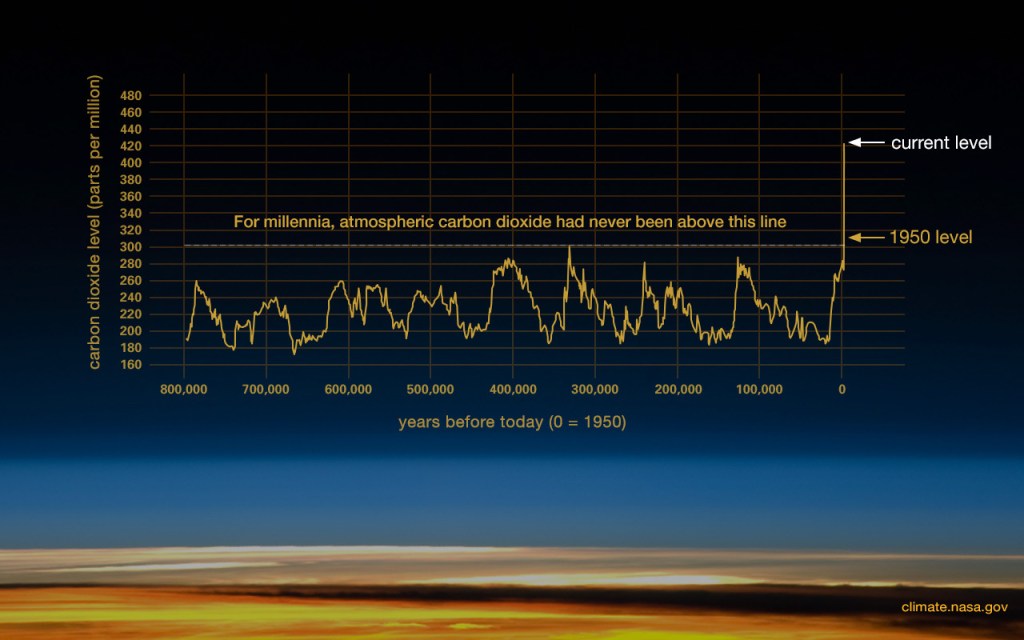
Nevertheless, from the author’s view, it would be less likely to argue that recent carbon dioxide levels are spurious or part of a broader pattern at the current time based only on the provided data for some reasons. First, more data points after 1950 might be needed to informally identify whether the levels of carbon dioxide are spurious and to obtain a sufficient sample size to be more convincing concerning a broader pattern of a temporary shift in the dynamics of the variable. Second, a spurious correlation can happen when two variables are correlated but do not have a causal relationship. With that being said, it appears like the values of one variable cause changes in the other variable, but that is not necessarily the case. Third, a serial correlation test might need to be conducted to check whether there is a relationship between a variable and its lags or successive values. By examining autocorrelation and partial autocorrelation, one can identify patterns in the data, understand how previous values impact future values, and make predictions about future outcomes.
Moreover, based on the data and their interpretation, it could be inferred arguments both for and against a relationship between global warming and carbon dioxide levels. The argument for the relationship between global warming and carbon dioxide levels might come from the fact that as the global warming issue has raised recently, carbon dioxide levels at the same time were significantly higher than its highest rate as well as its average level in the past 10,000 years when global warming was not an issue. There might be a correlation between the two variables. Nevertheless, correlation does not imply causality, which leads to the argument against the relationship between global warming and carbon dioxide levels.
It is important to note that it needs a robust regression analysis to argue whether there exists a causal relationship between the two variables. Even after finding some evidence of the relationship based on the regression results, one should interpret carefully as there might be other factors outside the time series regression that could help explain the relationship between global warming and carbon dioxide levels. For example, some activities such as road construction and deforestation can change the reflectivity of the earth’s surface, which might lead to a higher temperature and local warming (Fahey et al., 2017). It does not mean that what one could conclude by only looking at these time series is sufficient to understand the causality and recommend policies.
In conclusion, while the current warming of the Earth’s climate is unprecedented compared to the last 10,000 years, the relationship between global warming and carbon dioxide levels is a complex issue that requires further investigation. The influence of human activity on climate warming has been established as a fact by the IPCC, but understanding the causal relationship between global warming and carbon dioxide levels necessitates robust regression analysis and consideration of other contributing factors. To formulate effective policies and interventions, a comprehensive understanding of the dynamics of climate change and its drivers is crucial which can be explored through further research and analysis on the intricate interactions between global warming, carbon dioxide levels, and other factors influencing climate change.
References
Fahey, D.W., S.J. Doherty, K.A. Hibbard, A. Romanou & P.C. Taylor. (2017). Physical drivers of climate change. In: Climate science special report: Fourth national climate assessment, volume I [Wuebbles, D.J., D.W. Fahey, K.A. Hibbard, D.J. Dokken, B.C. Stewart & T.K. Maycock (eds.)]. U.S. Global Change Research Program: Washington, DC.
NASA
 hope.
hope. 